THE SAVVY BRIEF
Reviews Guides About
LEARNING & SKILLS
Learning Spanish as an Adult: What Matters When Choosing a Course
Choosing a Spanish course is easy. Choosing one that fits the way you’ll actually learn is harder. Here are the things worth looking at before you pay.
By Rafael Alt
The Savvy Brief · September 22, 2026 · 9 min read
Learning Spanish as an adult sounds simple until you actually try to do it.
Then your browser history starts filling up: vocabulary apps, audio courses, grammar videos, podcasts, YouTube channels, and tutors you meant to contact but never quite did.
Most of those things can teach you something.
The harder question is whether a particular approach can take you beyond recognizing words and phrases and help you use Spanish with some confidence.
That depends less on how polished an app looks than on a few fairly ordinary things: structure, repetition, listening, speaking, and whether the method fits into your life well enough that you’ll still be using it a few months from now.
The first few weeks are usually the easy part
A new language is unusually rewarding at the beginning.
You learn how to introduce yourself. Numbers start making sense. You recognize words on a menu. A sentence that looked completely unfamiliar a week ago suddenly clicks.
Progress feels fast because almost everything is new.
Then it slows down.
You know enough Spanish to realize how much you don’t know. Verb forms start multiplying. Native speakers seem to run words together. Vocabulary that felt secure last Tuesday disappears the moment you actually need it.
This is where the design of a course starts to matter.
A good beginner course shouldn’t depend on enthusiasm lasting forever. It should give you enough direction that, on a tired Wednesday evening, you don’t have to decide what to study.
You open it and continue.
That sounds like a small advantage. Over time, it can be an important one.
Structure matters more than most beginners expect
Self-directed learning has obvious appeal. If you’re confused about a grammar point, you can find a video. If you have twenty minutes on the train, you can listen to a podcast. If you hear a phrase you like, you can look it up immediately.
The problem is that beginners aren’t always in a good position to decide what should come next.
It’s easy to spend more time collecting material than actually learning from it. One day it’s a video on the past tense. The next it’s restaurant vocabulary. Then a podcast about Mexican slang, followed by a list of 500 common Spanish verbs. Before long, you have twelve open tabs and no clear idea what to study tomorrow.
A structured course removes some of that friction. It decides what you need first, what can wait, and when earlier material should come back.
That doesn’t mean the course has to feel rigid or academic. It does mean the sequence should make sense, especially at the beginning.
When you compare courses, the useful question isn’t “How much content does this include?” It’s “Does each lesson give me a clear reason to move to the next one?”
A smaller course with a coherent path can be more useful than a huge library of disconnected lessons.
Listening is where textbook Spanish meets real Spanish
Reading a sentence and understanding that same sentence when someone says it are two different skills.
On the page, the words stay still. You can reread them, pause over a verb, and work out the meaning at your own pace. In conversation, none of that happens.
Sounds blend together. Familiar words arrive faster than expected. Accents vary. Sometimes you can understand every word in a transcript and still struggle to hear those same words in the recording.
There isn’t really a shortcut around that. Listening improves by listening.
That makes the audio in a course more important than it may seem at first. Ideally, you should hear natural spoken Spanish early and often, rather than only isolated vocabulary pronounced slowly and clearly.
Slower recordings are useful when you’re starting out, but they shouldn’t be the only thing you hear. It also helps when a course makes it easy to replay short sections.
Listening to the same fifteen seconds of dialogue several times can teach you more than letting a long lesson play in the background while your attention is somewhere else.
You have to say the words out loud
This is the part many learners quietly avoid.
It’s possible to spend months studying Spanish without saying much of anything. You can recognize vocabulary, complete grammar exercises, and understand written sentences reasonably well—and still freeze when someone asks you a simple question.
Speaking is a different kind of skill.
At first, it will probably feel awkward. Your mouth is making unfamiliar sounds, your brain is assembling sentences in real time, and you can hear your own mistakes as they happen.
A course can’t remove that discomfort completely. What it can do is make speaking a normal part of the routine instead of something you postpone until you feel “ready.”
Look for exercises that ask you to produce language, not just recognize it. Repeating a sentence aloud, answering a simple prompt, or describing something in your own words all count.
Waiting until your pronunciation feels perfect is usually just another way of waiting.
Grammar is useful—but don’t use it as a hiding place
Some people genuinely enjoy grammar. There’s something satisfying about understanding why a sentence works. Verb charts can make the language feel more orderly. Rules give you something solid to hold on to.
Other people see a conjugation table and immediately lose interest.
Both reactions are understandable.
Grammar matters. At some point, you’ll need to deal with things like gender agreement, object pronouns, and the different ways Spanish talks about the past.
But understanding a rule and being able to use the language are not the same thing.
A course with almost no grammar can leave you guessing. A course that turns every lesson into a technical explanation can create the opposite problem: you may become very good at describing Spanish without becoming much better at using it.
For most adult learners, the useful middle ground is fairly simple: get a clear explanation, see it in context, and then do something with it.
Learn the rule, then give it a job.
Vocabulary is useless without a home
Memorizing individual words can feel productive because the progress is easy to measure. Twenty new words today. Another twenty tomorrow.
The problem is that vocabulary doesn’t live very well in isolation.
Knowing that viaje means “trip” is useful. Knowing how that word appears in a sentence you might actually need is much more useful.
Context gives vocabulary somewhere to stick. Short dialogues, useful phrases, and complete sentences help you remember not just what a word means, but how it behaves around other words.
They also expose you to grammar naturally. You begin to notice patterns before you necessarily know the name of the rule behind them.
Flashcards can still be valuable, especially for review. But they work best as support—not as the entire learning system.
Words are easier to remember when they belong to something.
The best course is the one you’ll actually open
This sounds obvious, but it’s one of the most important things to get right.
A course can be excellent on paper and still be a poor fit for your life.
If a typical lesson takes an hour and you realistically have twenty minutes, that matters. If you usually study while walking, commuting, or cooking, strong audio may matter more than elaborate on-screen exercises. If you dislike spending more time on your phone, an app-first course may become something you gradually stop opening.
Think about your real week, not your ideal one.
How much time do you actually have? When are you most likely to study? Do you prefer to sit down and concentrate, or learn in shorter bursts throughout the day?
A good course should challenge you. It shouldn’t create unnecessary friction.
The easier it is to return tomorrow, the more useful the course becomes.
Don’t confuse a streak with actual progress
Daily streaks can be useful. They encourage consistency, and consistency matters when you’re learning a language.
But a streak measures whether you showed up. It doesn’t necessarily measure what you can do.
It’s possible to maintain a long streak by repeating familiar exercises, choosing from multiple-choice answers, or completing activities that no longer ask very much of you.
Every so often, it’s worth checking your progress somewhere outside the app.
Can you understand a short piece of Spanish you haven’t seen before? Can you answer a simple question without rehearsing the sentence first? Can you remember a word when there are no prompts on the screen?
Those are less tidy measures, but they tell you more.
Consistency matters most when it is leading somewhere.
Apps, courses, and tutors: choosing the right tool
People often try to decide which format is “best.” In practice, they solve different problems.
An app can be useful for building a daily habit, reviewing vocabulary, and fitting short study sessions into a busy day.
A structured course can give you something different: sequence. It tells you what to learn next and reduces the amount of planning you have to do yourself.
A tutor adds another layer. A real person can respond unpredictably, notice recurring mistakes, adjust explanations, and force you to deal with Spanish that isn’t perfectly arranged in advance.
None of those tools has to do everything.
In fact, combining them can work well once you understand what each one is contributing. A course might provide the backbone, an app might handle quick review, and occasional tutoring might give you real conversation practice.
The mistake is assuming that more subscriptions automatically mean more progress.
Choose tools for a reason, not because you’re afraid one of them might be the missing piece.
What to look for before you pay
Spanish courses are sold in very different ways. Some charge monthly, some annually, and some offer lifetime access. None of those models is automatically better.
A low monthly price can become expensive if you keep the subscription for a long time. A larger one-time payment can make sense if the course is something you’ll genuinely use for years.
Free trials and refund periods are especially useful because they let you test the teaching method before committing.
Before paying, look past the feature list and try to answer a few practical questions.
How are the lessons organized? How much listening and speaking are included? Is the audio natural? How long does a typical lesson take? Can you easily review earlier material? And does the course make clear what you’re supposed to do next?
It’s also worth paying attention to what a course promises.
Learning a language takes time and repetition. A course can make that process clearer, more convenient, and easier to sustain. It can’t make the effort disappear.
Convenience is valuable. Effortlessness is a warning sign.
So, what actually matters?
For an adult beginner, the best Spanish course usually isn’t the one with the longest feature list or the slickest presentation.
It’s the one that gives you enough structure to know what to do next, enough real Spanish to train your ear, enough speaking practice to keep the language from living entirely in your head, and a format you can realistically return to.
Different learners will prefer different combinations of apps, courses, tutors, books, and audio. That part is personal.
The underlying requirements are less personal.
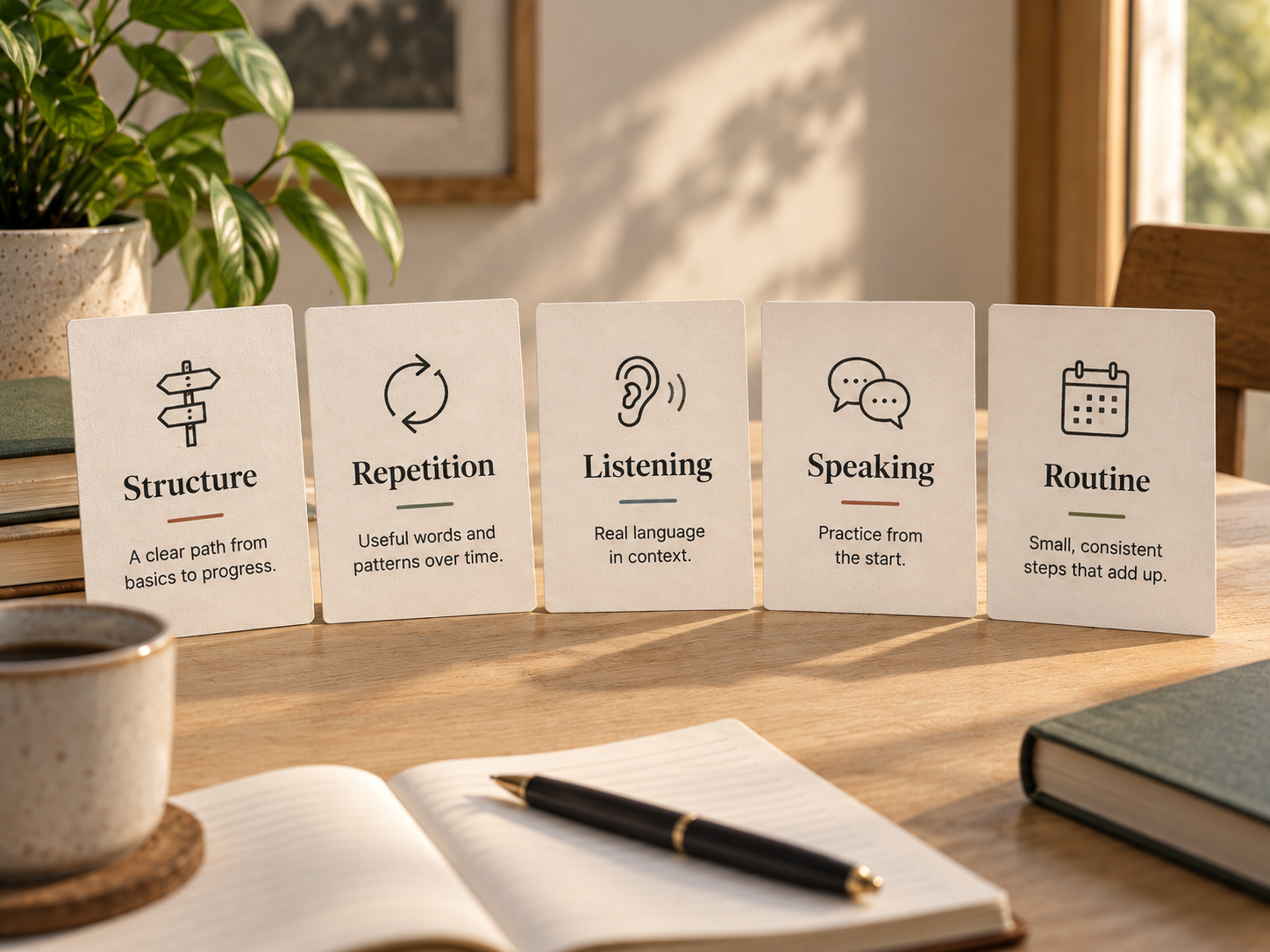
You need a clear path. You need repetition. You need to listen. You need to speak. And you need a routine that still works after the initial excitement has worn off.
The best course is the one that helps you keep going.